1.Page 297. " The Acherontia atropos of the Sphinges "

by
hector 


Death's-head Hawk Moth - Credit:
Orin ZebestAcherontia atropos is one of three species of
Death's-head Hawk moth. It is a particularly large moth, with a wingspan of up to five inches.
The species name is heavily connected with death. In Greek mythology, Atropos was one of the three goddesses of Fate and Acheron was the river of pain in the Underworld. The moth is completely harmless, but the skull pattern on the thorax has caused it to be associated with evil and misfortune.
"Sphinges" is the plural of sphinx, and refers to the hawk moth family,
Sphingidae.
2. Page 306. " flesh of my flesh; blood of my blood; kin of my kin "
by
victoriahooper 

The Creation of Eve - Credit:
Georges Jansoone/Wikimedia CommonsThis seems to be a reference to the Biblical creation of woman (
Genesis 2:23-24), when Eve was made using one of Adam’s ribs:
And Adam said, This is now bone of my bones, and flesh of my flesh: she shall be called Woman, because she was taken out of Man.
Therefore shall a man leave his father and his mother, and shall cleave unto his wife: and they shall be one flesh.
Dracula is insinuating that he has re-made Mina in his own image – a vampire!
3. Page 321. " the highest development of the science-knowledge of his time "
by
sammycumes 

Alchemist's Laboratoy - Credit:
Heinrich KhunrathAlchemy was popularly understood to be the mystical science of turning base metals into gold, but in fact it was a much broader discipline.
Alchemy was more like a philosophy, incorporating ideas like transmutation, immortality and self-awareness.
The word "alchemy" stems from the Arabic "al-kimia" meaning "the art of transformation". However the earliest alchemists are believed to have worked in China or the Persian Empire. Modern inorganic chemistry owes much to early alchemical investigations.
4. Page 323. " the Devil, though he may purchase, does not keep faith "
by
onelittlething  19th century engraving of Homunculus from Goethe's Faust part II
This may refer to the story of
Faust.
Faust is a successful doctor or alchemist, but dissatisfied with his life he
sells his soul to the devil in exchange for knowledge and pleasure. Although he seems to get what he asks for, he ends up condemned to an eternity in Hell.
The Faust story has been reworked through the ages and appears in many forms. Best known are two plays:
Doctor Faustus by
Christopher Marlowe(1564-1593), and
Faust by
Johann Wolfgang von Goethe (1749 - 1832).
5. Page 325. " for he had ready his great Kukri knife "
by
victoriahooper 
Kukri Knife - Credit:
Sonett72/Wikimedia CommonsA
Kukri knife is a close combat weapon with an inwardly curved cutting edge. It is the icon of Nepal, and used by the Gurkhas.
6. Page 332. " I want you to hypnotise me "
by
victoriahooper 
A Victorian Hypnotist - Credit:
Library of CongressVictorian readers were very familiar with hypnotism. Scottish surgeon
James Braidintroduced the concept of neuro-hypnotism (neural sleep) in 1841, and by the 1890s it was being used to treat the widespread disorder of
hysteria. While Stoker was writing Dracula,
Sigmund Freud was developing the practice of regression hypnotherapy.
At the same time, hypnosis was already in demand on the stage. Indeed James Braid took his inspiration from a "mesmerism" show.
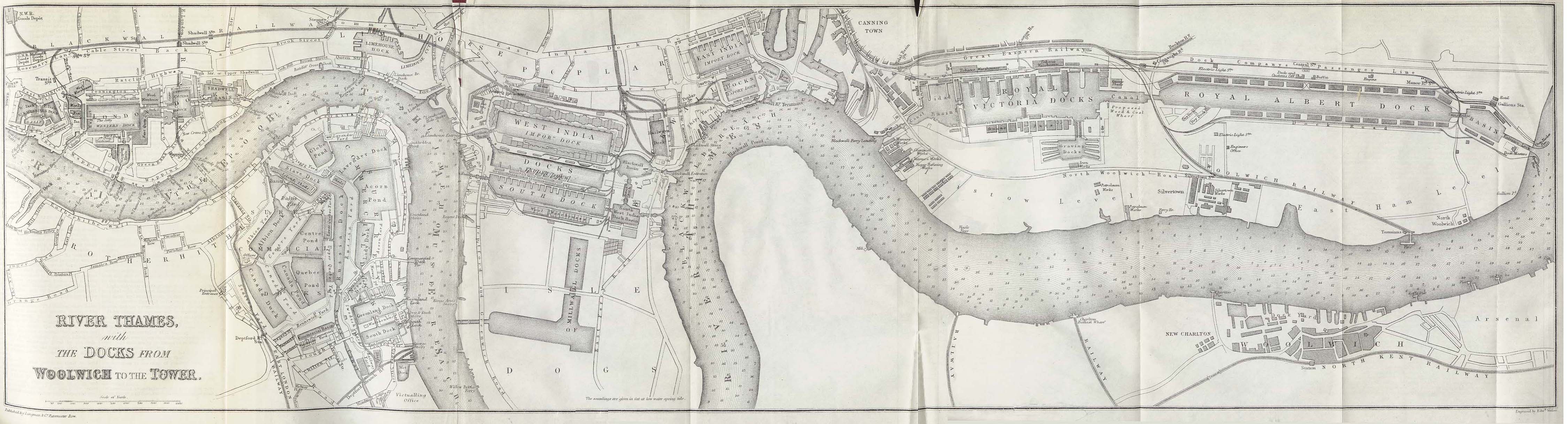
7. Page 333. " your so great Port of London "
by
hector 

The Pool of London, 1841 - Credit:
W. ParrottLondon has been a significant maritime trading port since Roman times. With the growth of the British Empire, it became the busiest port in the world during the 18th and 19th centuries. For nearly two millenia, most loading and unloading took place in the
Pool of London, the stretch of the River Thames from London Bridge to Rotherhithe. But by the end of the 18th century, demand for quayside space had outstripped capacity, and throughout the 19th century private companies constructed new enclosed docks in what became known as
Docklands.
Although Docklands was very heavily bombed in World War II, and has now been redeveloped for office and residential use, London remains one of the largest ports in Britain, with new docks further downriver. Its capacity will increase considerably with the completion of the massive deep-water port at
London Gateway.
Map of London's Docks, 1882
London Docks, 1845 - Credit:
Illustrated London News
8. Page 334. " Tally Ho "
by
victoriahooper 
Fox Hunters - Credit:
Henrik Jessen/Wikimedia Commons ‘Tally Ho’ is the traditional cry of the fox-hunter.
Fox-hunting was a sport enjoyed by the upper classes in Britain until a ban on the activity in 2005 (though it is still practised in many other countries).
A group of hunters riding horses would follow a pack of hounds trained to track and chase foxes. A red coat is traditional fox-hunting attire.
9. Page 337. " he must go by the Danube mouth "
by
victoriahooper 
The Danube Delta in Romania - Credit:
Danutz/wikimedia commonsThe
Danube drains into the Black Sea via the
Danube Delta, the greater part of which is situated in Romania, with a smaller, northern part in the Ukraine.
A delta forms when the sediment carried by a moving river reaches a body of still or slower moving water, and spreads out to form a wide area of deposited sediment, often in the shape of the Greek letter Delta.
10. Page 340. " There are deep caverns and fissures "
by
hector 
Timisoara Cave - Credit:
Francisco GonzalezThere are indeed some fine caves in Transylvania. Romania as a whole boasts over 12,000 caves, many of them in the Carpathians.
For the adventurous who want to explore them, here are a couple of options:
Outdoor Holidays Green Mountain Holidays
Muierilor Cave - Credit:
Cristian Bortes